
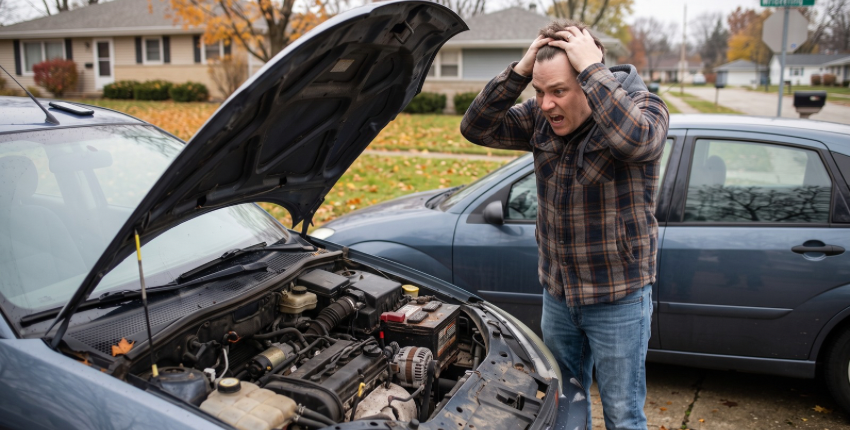
Have you ever walked out to your car on a Tuesday morning, turned the key, and heard nothing?
Not a cough. Not a sputter. Maybe one sad little click.
Then you stand there in the driveway, half a cup of coffee in your hand, staring at your car like it personally betrayed you.
When a car won’t start, most people blame the battery. Sometimes they’re right. Sometimes the problem is the starter, alternator, wiring, or a loose connection. I’d guess about eight out of ten customers tell me it’s the battery before we’ve even popped the hood, and about half the time they’re wrong.
Because these parts work together, testing the entire starting and charging system is the best way to find out what’s actually wrong. Here’s the simple version of what each part does and what you might notice when it starts failing.
The Battery Gets Everything Started
Your battery stores electricity and provides the big burst of power needed to start the engine.
Once the engine is running, the alternator becomes the main source of electrical power. The battery stays ready in the background and helps keep the system stable.
A weak battery may still operate the radio, interior lights, and other electronics. Those accessories require much less power than starting the engine. That’s why the lights can come on even when the battery doesn’t have enough strength to start the car.
Most batteries last around three to five years, though driving habits, weather, and the vehicle itself can make a difference.
Northern Illinois weather does batteries no favors. Summer heat wears down the internals, then winter turns around and demands more power from a battery that’s already half beat up. Summer does the damage. Winter gets the blame. I tell customers that every fall, and most of them still call me surprised in January.
Common signs of a weak battery include:
- Slow cranking when you start the car
- Clicking when you turn the key
- Electrical accessories acting sluggish
- Needing frequent jump-starts
- Corrosion around the battery terminals
That corrosion isn’t something to shrug off, either. I got some in my eye years ago poking around a battery, and I ended up at urgent care getting it flushed out. Not fun. The eye patch I got to wear for a day afterward was pretty cool, but I’d skip the whole experience if I could do it again. Wear eye protection around a battery, corrosion or not.
If the battery is more than three years old, having it tested periodically is a good idea. A battery test only takes a few minutes, and it can give you some warning before you’re standing in the driveway holding that coffee.
The Starter Turns the Engine Over
The starter is a powerful electric motor that physically turns the engine when you turn the key or press the start button.
It only works for a few seconds at a time, but it needs a lot of electrical power to do its job.
A failing starter can cause a single loud click, slow cranking, or no response at all. It might also work fine one day and refuse to cooperate the next.
That makes the problem hard to pin down. Electrical problems have a bad habit of behaving perfectly the second the vehicle reaches the shop. I’ve had cars sit in my bay for two days waiting to act up again just so we could actually catch it on the meter. Apparently, they understand job security.
A click doesn’t automatically mean the starter is bad, though. A weak battery, a loose connection, a corroded terminal, a bad relay, or a poor ground can all cause the same symptom. That’s why we test the battery and the connections before anyone touches the starter.
The Alternator Keeps the Electricity Flowing
Once the engine is running, the alternator generates the electricity that runs the vehicle and recharges the battery.
If the alternator stops charging, the vehicle may keep running for a while on whatever’s stored in the battery. How long depends on the battery’s condition and how much electrical load the vehicle is pulling.
Eventually the battery runs down and the engine shuts off.
Alternator trouble can look a lot like battery trouble. You might notice:
- A battery-shaped warning light on the dashboard
- Headlights or interior lights that flicker or dim
- Slow power windows or other odd electrical behavior
- A whining or grinding noise from under the hood
- A vehicle that starts after a jump but dies again later
- A new battery that keeps going dead
That battery warning light is a little misleading. It usually means there’s a problem with the charging system, not necessarily that the battery itself is old.
If that light comes on while you’re driving, don’t assume you can finish the day and deal with it later. Turn off whatever electrical accessories you don’t need and get the vehicle checked as soon as it’s safe to.
A bad alternator can drain a good battery over and over, and in some cases it can overcharge and damage one outright. I don’t let my guys hand a customer a new battery until we’ve checked the alternator too. I’ve watched people buy two batteries in a row because nobody checked what was actually killing the first one.
Wiring Connects Everything
The battery, starter, and alternator all rely on cables, wires, grounds, switches, relays, fuses, and connectors to do their jobs. Think of the wiring as the vehicle’s nervous system. When it’s all connected and talking to each other the way it should, you never think about it. When something goes wrong, the vehicle starts acting like it’s developed a mind of its own.
A window that decides to work on Mondays but not Fridays. Lights that flicker for no reason. A battery that’s dead by morning. A car that starts nine times and refuses the tenth. That’s not a mystery. That’s your car.
Possible causes include:
- Loose or corroded battery connections
- Damaged wiring
- Poor ground connections
- Worn switches or relays
- Water in electrical connectors
- Rodent damage
- Improperly installed aftermarket accessories
- A module that doesn’t shut down when the vehicle’s turned off
I’ve pulled apart wiring harnesses that looked like a family of mice had a housewarming party in there. It happens more than people think, especially with vehicles parked outside near trees or fields.
Intermittent electrical problems take time to diagnose because the problem isn’t always happening while the vehicle’s on the lift. Finding the cause can mean checking voltage, testing grounds, measuring current draw, following wiring diagrams, and inspecting individual circuits by hand. Scan tools and live data help narrow things down, but there’s no magic button that finds every electrical gremlin. Sometimes it just takes real testing and a little detective work.
Why Testing the Whole System Matters
The battery, starter, alternator, and wiring don’t operate independently.
A weak battery can make the starter crank slowly. A worn starter can draw too much electricity. A failing alternator can drain the battery over and over. A loose or corroded ground can make perfectly good parts look bad.
Sometimes something keeps drawing electricity after the vehicle’s shut off. That’s called a parasitic draw, and it can leave you with a dead battery even when both the battery and alternator test fine on their own.
That’s why I won’t let a battery get replaced just because the car wouldn’t start. I want to know why it wouldn’t start. Testing first is almost always cheaper than throwing parts at a problem and hoping one of them sticks.
What You Can Do
Pay attention to how your vehicle starts. If it starts cranking slower than usual, don’t wait until it stops cranking altogether.
Get the battery tested once it’s past three years old, especially before winter or a long trip.
If the battery warning light comes on while you’re driving, get the charging system checked promptly.
And don’t ignore flickering lights, repeated dead batteries, or electrical accessories that only work when they feel like it. Intermittent problems don’t fix themselves. They wait for a worse time to become permanent.
If your vehicle’s cranking slowly, showing a battery warning light, or doing something electrical that doesn’t add up, bring it in and we’ll test the starting and charging system to find out what’s actually causing it. I’d rather test it and tell you it’s fine than sell you a part you didn’t need.
Because replacing the wrong part is an expensive way to keep having the same problem.
Back when you are
Schedule your next oil change online, or give us a call, whichever’s easier for you.
Book online → Schedule your service online
Or give us a call:
DeKalb: 112 Industrial Dr. | 815-754-4200
Sycamore: 2158 Oakland Dr. | 815-756-7413
About the Author
Jon Bockman has owned Bockman’s Auto, Truck and Tire since 1999, continuing what his father Charlie started in DeKalb County in 1964. Named NAPA Shop of the Year (from 18,000+ centers) and voted Best Auto Repair in Daily Chronicle Readers’ Choice 15 times. Two locations, 24 employees, one goal: treat every customer like a neighbor.