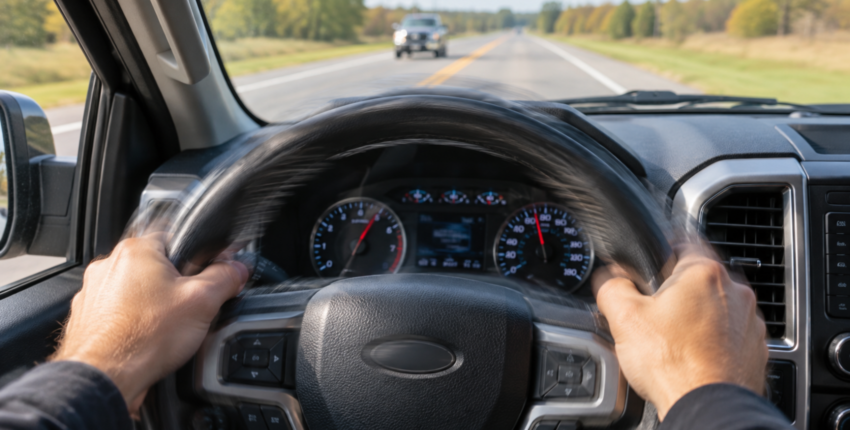
Your steering wheel starts shaking under your hands and suddenly you’re gripping it like you’re trying to wrestle it into submission. First thought: something is very wrong with this car. Second thought: how much is this going to cost? I get it.
Take a breath. Most of the time your car is telling you something, not falling apart. And when it shakes tells us a lot about why it shakes. Only when you brake? Only on the highway? Only when you step on the gas? Each answer points at a different part of the car.
Why Does My Steering Wheel Shake When I Brake?
If the wheel shakes when you step on the brakes, it’s usually the brakes. You’ll often notice it first slowing down on an exit ramp off I-88 and the harder you brake, the worse it gets.
Behind each wheel is a flat metal disc called a rotor. Your brake pads squeeze it to stop the car. When that disc wears uneven, or picks up rust or a spotty buildup on its surface, it isn’t smooth anymore. Every time the pads grab it, they pulse. That pulse travels right up into your hands. Fun times. (You’ll hear people call this a warped rotor. Usually it isn’t actually bent, it’s just worn or crusted unevenly. Same shake either way.)
Brake pads worn down to nothing cause their own trouble. Once the pad is gone it’s metal grinding on metal. You’ll usually hear that before you feel it and it chews up the rotor fast, which brings the shake right along with it. A brake that sticks (it doesn’t fully let go after you take your foot off the pedal) can do it too.
Road salt doesn’t help. Our cars spend all winter in the stuff here in DeKalb County and a rotor that rusts unevenly pulses just like one that’s worn out. Brake shakes don’t fix themselves, they get worse. The fix might be new pads, new rotors, resurfacing the rotors you’ve got, or some mix of those. We won’t know which until we measure them.
Why Does It Only Shake at Highway Speed?
Smooth around town. Then you get on I-88, hit 55 or 60 and the wheel starts dancing. That’s a different problem and the first place we look is the tires and wheels.
The most common cause is a wheel that’s out of balance. Every wheel has small weights on it so it spins evenly. Lose one, or let the tire wear unevenly and the wheel starts to wobble. A balance problem usually kicks in somewhere around 55 and gets stronger as you go faster.
Then there are potholes. (DeKalb County grows a fresh crop every spring and some of them are the size of swimming pools.) One hard hit can bend a wheel. It looks perfectly fine sitting in your driveway, but get it up to speed and the wobble shows up. Tires can go bad on their own too. One can wear in a lumpy pattern, or the layers inside it can shift so it isn’t perfectly round anymore. And in winter it can be as simple as snow, ice, or mud packed inside the wheel. (Honestly, that’s the best case.)
If the tires and wheels check out, we move on to the parts that hold your wheels to the car and connect them to your steering wheel. Quick translation, since you’ll hear these names: tie rods connect your steering wheel to your front wheels and when they wear loose the wheels have room to wobble. Ball joints are the pivots your front wheels turn on and worn ones get sloppy. Wheel bearings let each wheel spin smoothly and a bad one makes a wobble (usually with a hum or growl that gets louder the faster you go).
Potholes do a lot of this damage too. One hard hit can bend a tie rod or knock a ball joint loose. So the shake you’re feeling today might trace back to that pothole you hit last month and forgot about.
Why Does My Car Shake When I Accelerate?
If the shake shows up mostly when you step on the gas, that points somewhere else. The usual suspects are the parts that carry power from the engine out to the wheels: the axles on a front-wheel-drive car, the driveshaft and u-joints on a truck or rear-wheel-drive car and the rubber mounts that hold the engine and transmission in place. When those wear out, you feel it every time you ask the car to pull. A tire that’s damaged on the inside can do it too.
One more clue: where you feel it. A shake in the steering wheel usually points us at the front of the car. A shake in your seat or through the floor is more often coming from farther back. Those are good clues but they’re not a diagnosis.
Can a Bad Alignment Make My Steering Wheel Shake?
Not usually by itself. A bad alignment makes the car pull to one side, leaves the steering wheel crooked when you’re driving straight, or wears your tires unevenly. That last one is the catch. Drive on a bad alignment long enough and the tires wear lumpy and lumpy tires do shake.
So we check the alignment, but we don’t blame it until we’ve checked everything else. When parts are worn or bent, we replace them first and then do the alignment, so the fix actually holds.
Is It Safe to Keep Driving?
A slight shake that crept in slowly can usually wait a few days for an appointment. Don’t let it go for months. Some shakes can’t wait at all. If it came on suddenly, it’s bad or getting worse, the car pulls when you brake, the steering feels loose, you hear grinding, clunking, or thumping, your tire pressure light comes on, or you can see a bulge or damage on a tire, slow down and get it looked at. Not next week. Now.
And if the car feels hard to control, or you think a tire is about to go, don’t drive it. Call a tow. A tow bill is a lot cheaper than a wreck.
How We Find It
We’ll ask you when it shakes (that’s why the first half of this post matters). Then we do a digital vehicle inspection. We measure the brake rotors, check the tires and wheels, test the balance, check the alignment and look over the steering and suspension parts for wear. You’ll see the photos and the findings in your report: what we found, what we’d fix and what it costs. Then it’s your call.
I don’t want us selling you a wheel balance when the real problem is a damaged tire. And I don’t want us selling you brakes when the shake is coming from a loose steering part. Find the cause first then fix it.
Feel a shake, either kind? Bring it in and we’ll find out why.
Book online → Schedule your service online
Or give us a call:
DeKalb: 112 Industrial Dr. | 815-754-4200
Sycamore: 2158 Oakland Dr. | 815-756-7413
About the Author
Jon Bockman has owned Bockman’s Auto, Truck and Tire since 1999, continuing what his father Charlie started in DeKalb County in 1964. Named NAPA Shop of the Year out of more than 18,000 centers, and voted Best Auto Repair in the Daily Chronicle Readers’ Choice 16 times. Two locations, 24 employees, and one goal: treat every customer like a neighbor.