Ask ten drivers how often they change their oil and you’ll get ten different answers, and half of them will argue with you about it. Some are still running on the “every 3,000 miles” rule their dad drilled into them. Others read somewhere that modern oil goes 10,000 miles and figure that means they can forget about it. Neither one is crazy. They’re just working off information that’s out of date, or too general for their actual car.
I’ve had guys tell me they looked it up online before I even got a word out. I always tell them the same thing: we really know how the internet is always right. It’s not that they’re dumb for checking, it’s that a general number off a general website isn’t the same as an answer for their specific engine and how they actually drive it.
The Manufacturer Says 10,000. I Say 8,000. Here’s Why.
I’ll be straight with you, this is my own call, not something every shop will tell you. A lot of manufacturers will say you’re fine going up to 10,000 miles on synthetic oil. I don’t push that number on my customers, and I want to explain why, because it’s not just me being cautious for no reason.
That oil-life figure on your dashboard doesn’t come from anyone actually testing your oil. Depending on the vehicle, it’s an algorithm built off things like mileage, engine speed and load, operating temperature, trip length, and idle time. It’s estimating how much life the oil has left. It is not measuring how much oil is actually sitting in your pan.
Here’s where that matters. Some engines burn oil, and manufacturers actually publish acceptable consumption rates for their own engines, in some cases as much as a quart every 1,000 to 2,000 miles. That doesn’t automatically mean the manufacturer considers the engine defective. But acceptable by their specification and nothing to worry about are two different things, because that oil still has to get checked and topped off in between changes.
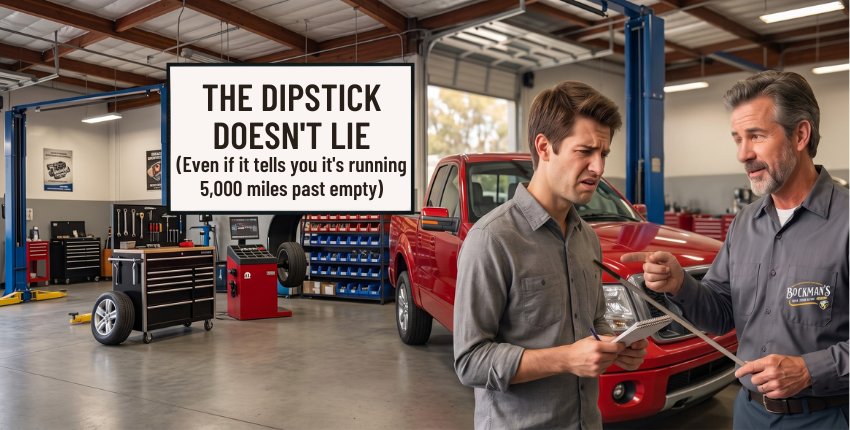
Now put those two things together. The oil-life monitor usually doesn’t know how much oil is physically in the engine. Some vehicles have a separate oil-level warning, but that isn’t the same thing as the oil-life percentage counting down on your dash. If you’ve got a car that burns oil and you ride that monitor out to 10,000 miles without ever checking the dipstick, you could be dangerously low on oil, even though the dashboard still shows life remaining.
And here’s the part I really believe, based on what we see every week: most people don’t check their oil anymore. It’s not laziness, it’s just that the car tells you everything else now, so people trust the computer and stop doing the one manual check that used to be automatic.
So my honest recommendation, mine, not the manufacturer’s and not universal, is 8,000 miles tops on synthetic. But the oil level still needs to be checked between changes. I recommend checking it at least monthly and before a long trip. An earlier oil change doesn’t protect an engine that runs low several thousand miles before that change is due. Checking and topping off is what actually saves it.
Conventional or Synthetic? Here’s the Honest Difference
Conventional oil is refined from crude and has been doing the job for decades. It costs less, and for a lot of older vehicles or low-mileage drivers, it works just fine. Where it struggles is in extreme heat, extreme cold, or hard driving, where it breaks down faster than you’d like. On conventional, I’d still tell most people 3,000 to 5,000 miles, always within whatever oil type and spec your manufacturer actually requires. Older car doesn’t automatically mean conventional is the right call.
Synthetic oil is more extensively refined and engineered to perform consistently across a wider range of temperatures. It resists breakdown longer and keeps the engine cleaner. That’s why most newer vehicles are designed around it, and why a lot of manufacturers require it. Just don’t let “longer-lasting” turn into “never check it.”
Your Driving Habits Matter More Than the Odometer
Short trips, stop-and-go traffic, towing, idling a lot, extreme heat or cold, dusty roads, all of that puts extra stress on your oil even if the odometer barely moves. So two people with the identical car and the identical mileage might genuinely need to be on different schedules. That’s not us upselling one of them. That’s just how the oil actually wears.
What About the Oil Life Monitor on the Dash?
It’s a useful tool, and it’s generally more accurate than just going by mileage alone with no other information. But like I said above, it’s an estimate, not a measurement of what’s actually in the pan. It won’t detect a slow oil leak or tell you the engine is consuming oil, unless your vehicle has a separate oil-level monitoring system. That’s the part a computer can’t do and a second set of eyes can.
Why We Look at More Than the Oil While We’re In There
An oil change is our excuse to go over the rest of the vehicle while it’s already up on the lift. Tires, brakes, fluid levels, battery, belts, hoses, any leaks, all of it. Not because we’re hunting for something to sell you, but because catching a small problem now is a lot cheaper than a breakdown later.
I’ve told guys over the years, if you’re putting off brake work on the car your wife or your kid drives, ask yourself why that’s the one you’re comfortable letting slide. It usually gets the point across faster than any brochure would.
Not Sure What Your Vehicle Actually Needs?
Every vehicle is different, and the right oil and the right interval depend on your engine, your mileage, how you drive, and what the manufacturer actually calls for. Not a sticker slapped on your windshield at the last quick-lube place, and not whatever a forum post told you either.
If you’re not sure whether you should be running synthetic or conventional, or when you’re actually due, just ask us. We’ll give you a straight answer for your car. And if you want to argue about it, I’ll be honest, I’m not going to get into an argument over facts. I’ll just tell you what’s true and let you decide.
Ready when you are
Schedule your next oil change online, or give us a call, whichever’s easier for you.
Book online → Schedule your service online
Or give us a call:
DeKalb: 112 Industrial Dr. | 815-754-4200
Sycamore: 2158 Oakland Dr. | 815-756-7413
About the Author
Jon Bockman has owned Bockman’s Auto, Truck and Tire since 1999, continuing what his father Charlie started in DeKalb County in 1964. Named NAPA Shop of the Year (from 18,000+ centers) and voted Best Auto Repair in Daily Chronicle Readers’ Choice 15 times. Two locations, 24 employees, one goal: treat every customer like a neighbor.