In part one, we talked about how a tune-up used to be a specific job with a specific list of parts. On a modern car, most of that list doesn’t even exist anymore. So when somebody asks us for a tune-up today, we’ve learned to ask one question right back before we quote a single thing. Are you due for maintenance, or is your car running poorly?
It sounds like a small question, but it’s actually the whole ballgame. Your answer leads to one of two very different conversations.
Door Number One: You Just Want to Stay on Top of Things
Maybe the car runs fine. You just know it’s been a while, and “tune-up” is your shorthand for “give it whatever it’s supposed to have by now.” Good. That’s the smart road, and it’s usually the cheaper one.
On a modern vehicle, what you’re really asking for is scheduled maintenance. Depending on your mileage, that might mean fresh spark plugs, new fluids and clean filters, a look at the belts and hoses, and a check of the parts that tend to wear out quietly.
A lot of this is stuff you’d never notice slipping until it actually quits on you, which is always the worst possible moment to find out. Doing it on schedule is how you stay off the shoulder of Route 23 in the rain.
Door Number Two: The Car is Actually Acting Up
This is the other reason folks say “tune-up,” and it’s a totally different situation. Now we’ve moved from maintenance into diagnosis.
Customers often hand over the keys and say, “It shakes at stoplights, struggles to accelerate, and the check engine light flashes sometimes.” Maybe the car is hesitating, stalling at the light, or your gas mileage just fell off a cliff. Something is wrong, and tune-up is simply the word you reached for. Here’s the honest part. There is no single part we can swap to “tune up” a problem like that.
Why Guessing Gets Expensive Fast
When a vehicle starts running poorly, people naturally want the quickest, cheapest fix. But modern drivability problems can come from a lot of places. Sometimes worn spark plugs really are the issue. Other times it’s a failing ignition coil, a bad fuel injector, a vacuum leak, a sensor problem, carbon buildup, a timing issue, or even low compression inside the engine. The tricky part is that a lot of those problems feel exactly the same from the driver’s seat.
We sometimes see a vehicle come in after someone already threw new spark plugs and coils at it themselves. If it still runs rough, they’ve already spent the money and the original problem is still sitting right there.
And here’s one worth taking seriously. A flashing check engine light is not something to sit on. It usually means the engine is misfiring badly enough to damage the catalytic converter, and those are not cheap!
The Power of Diagnostics
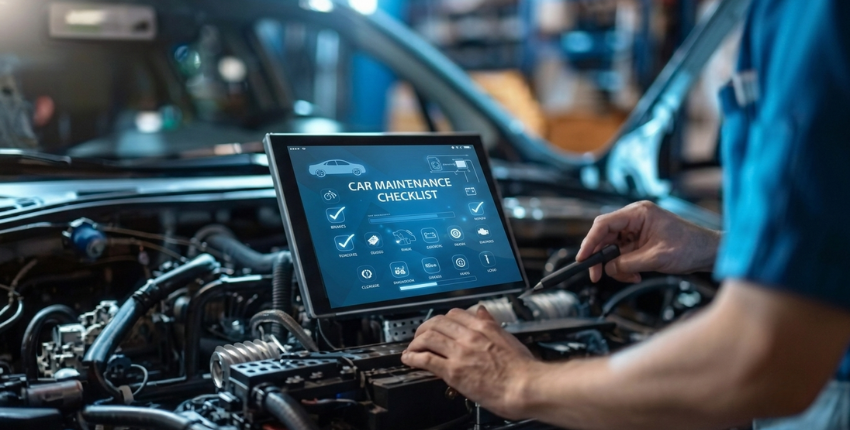
Modern diagnostics are less about guessing and more about narrowing things down step by step. A technician might scan the computer data, test the fuel pressure, inspect the ignition patterns, look for vacuum leaks, and watch the live engine readings while the vehicle is running.
We call that diagnostics, not a tune-up. That difference matters to your wallet. If a shop sells you a “tune-up” when what you’ve really got is a failing sensor, you just paid for parts that fixed nothing.
Why We Bother Asking
This really comes down to not wasting your money. If you need maintenance, we do maintenance. If something’s broken, we find it and fix the actual problem. Lumping both of those under one old word is exactly how people end up paying for the wrong thing.
So keep using the word tune-up. We’re not going to correct you, promise. We’re just going to ask one friendly question first, because your answer is what tells us how to actually help.
Book online → Schedule your service online
Or give us a call:
DeKalb: 112 Industrial Dr. | 815-754-4200
Sycamore: 2158 Oakland Dr. | 815-756-7413
About the Author
Jon Bockman has owned Bockman’s Auto, Truck and Tire since 1999, continuing what his father Charlie started in DeKalb County in 1964. Named NAPA Shop of the Year (from 18,000+ centers) and voted Best Auto Repair in Daily Chronicle Readers’ Choice 15 times. Two locations, 24 employees, one goal: treat every customer like a neighbor.