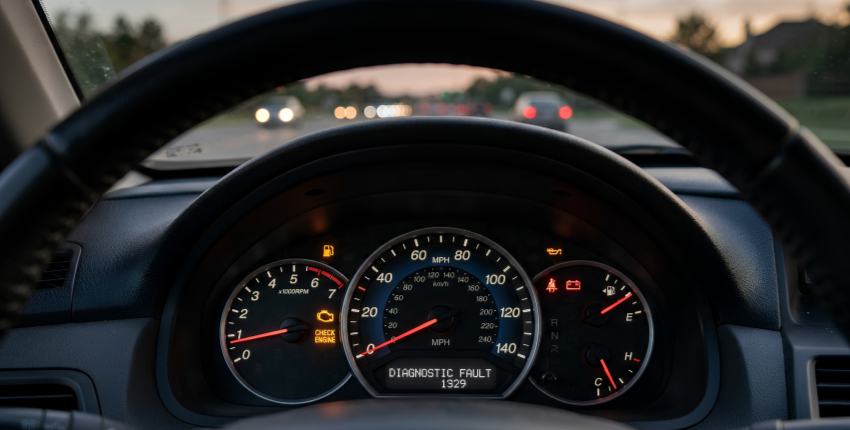
That little amber glow shows up on your dashboard, and your stomach drops a little. Is the car about to die on the way home? Is this a fifty dollar fix or a fifteen hundred dollar one? Should you pull over right now, or finish the grocery run first?
The check engine light is one of the most misunderstood things on your dashboard. Some people panic the second it appears. Others have been driving around with it on for three months and treat it like wallpaper. Both groups are guessing, and guessing is the expensive way to own a car.
Here’s the truth: the check engine light is not a verdict. It’s a messenger. And once you understand what it’s actually telling you, that amber glow gets a lot less scary.
What the Check Engine Light Actually Means
Your car has a computer. More than one, actually, but the main one keeps an eye on the engine and the systems around it. When a sensor reports something outside the range it expects, the computer logs a code and turns on the light to get your attention.
That’s it. The light means “something is reporting a value I don’t like.” It does not tell you, on its own, whether that something is a loose gas cap or a failing transmission. Two cars with the exact same light on can have wildly different problems.
This is why “what does the check engine light mean” doesn’t have one answer. It means your car noticed something. Figuring out what that something is takes a scan tool and someone who knows how to read what comes back.
Steady Light vs. Flashing Light: This Distinction Matters
Before you do anything else, look at how the light is behaving. This is the one thing you can read yourself, and it changes how urgent the situation is.
A steady check engine light usually means something needs attention, but you are not in immediate danger. You can typically keep driving carefully and get it looked at soon rather than this exact second. Think days, not weeks, but it’s not a roadside emergency.
A flashing check engine light is a different animal. A blinking light usually means an active engine misfire, which means raw fuel is dumping into your exhaust system. That can overheat and damage your catalytic converter, which is one of the pricier parts under your car. If your light is flashing, ease off the gas and get the vehicle to a shop as soon as you safely can. Keep your speed and load light on the way.
So the quick read is simple. Steady means handle it soon. Flashing means handle it now.
One exception worth knowing. If your check engine light shows up along with other warning signs, low oil pressure, overheating, a severe loss of power, smoke, or unusual noises, don’t keep driving to see what happens. Pull over when it’s safe and have the vehicle looked at right away. Those are the cases where waiting turns a repair into a replacement.
The Most Common Reasons the Light Comes On
People are often surprised by how ordinary most check engine light causes are. The dramatic failures make for good stories, but the everyday culprits are pretty mundane. Here are the ones we see most often.
A loose or failing gas cap. Yes, really, though less often than the old wisdom suggests. On newer vehicles this one’s rarer than people think, but your fuel system is sealed and the gas cap is part of that seal, so a loose or cracked one can still trip an emissions code. It’s also the one thing on this list you can check yourself for free, so tighten it until it clicks before you assume the worst. If the light clears after a few drives, you got lucky.
A failing oxygen sensor. This little sensor measures how much oxygen is in your exhaust, which tells the computer how to balance the fuel mixture. When it goes bad, your fuel economy drops and your emissions go up. Ignore it long enough and it can take your catalytic converter down with it, so this one is worth not putting off.
A bad mass airflow sensor. This part measures how much air is entering the engine so the computer can add the right amount of fuel. A dirty or failing one makes the engine run rough, stall, or guzzle gas.
Worn spark plugs or ignition coils. These create the spark that fires your engine. When they wear out, you get misfires, rough idling, and that flashing light we talked about. On modern engines, ignoring this gets expensive fast.
A failing catalytic converter. This is the big one nobody wants to hear. The catalytic converter cleans up your exhaust, and when it fails, it’s a real repair. The frustrating part is that a lot of catalytic converter failures start as a small problem somewhere else, like a bad oxygen sensor or an ongoing misfire, that nobody addressed in time. The cheap fix you skipped becomes the expensive one you can’t.
Notice the pattern there. A lot of the scary, costly repairs begin life as a cheap, easy fix that got ignored. The light was trying to help.
Why You Can’t Just Trust the Parts Store Code Reader
You may have heard you can get the code read for free at an auto parts store, and that’s true. They’ll plug in a scanner and hand you a code, something like P0420 or P0171. That’s a nice free starting point, and we’re not knocking it.
But here’s where people get into trouble. That code is a symptom, not a diagnosis. A code like P0420 says “catalyst system efficiency below threshold.” It does not say “replace your catalytic converter.” It says the system isn’t running as cleanly as it should, and there are a half dozen reasons that could be true. The converter might be fine. The real problem might be a sensor, an exhaust leak, or a misfire upstream.
We’ve seen folks buy a six hundred dollar part based on a free code, install it, and watch the light come right back on because the part was never the problem. The code points you to a neighborhood. It doesn’t give you the address.
That’s the difference between reading a code and diagnosing a problem. The code reader is the easy part. Figuring out the actual cause is the work.
What Real Diagnostics Look Like at Bockman’s
When you bring your vehicle to us with the light on, we don’t just read the code and start guessing. We pull every code the computer has stored, including the ones a basic reader skips, and we look at the live data the engine is reporting while it runs. That tells us what’s actually happening, not just what tripped the alarm.
From there it’s detective work. We test the components the code points toward, rule out the things it isn’t, and track the problem to its actual source. Sometimes that’s quick. Sometimes a stubborn intermittent issue takes longer to pin down, because the hardest problems are the ones that only show up when they feel like it.
This is also where our Digital Vehicle Inspection earns its keep. You get photos and findings sent right to your phone, so when we tell you the oxygen sensor is the culprit, you can see what we’re seeing. We’ll tell you what we found and what we recommend, and then the decision is yours. No pressure, no mystery, no “trust us.” Just the actual picture of your car.
Why DeKalb County Driving Is Hard on These Systems
Our winters don’t do your sensors any favors. The freeze and thaw cycle, the road salt, the temperature swings from a frozen morning to an afternoon thaw, all of it puts stress on the electrical connections and sensors that keep your engine running clean.
Cold starts are especially tough. Every frigid January morning, your engine and its sensors warm up from well below freezing, and over enough winters those repeated extremes wear on the components. Oxygen sensors and mass airflow sensors live a harder life here than they would in a mild climate.
Road salt is the other quiet troublemaker. It finds its way into electrical connectors and corrodes them, and corrosion can throw codes that look like a failed part when the real issue is a bad connection. Knowing the difference is part of why local experience matters. We’ve been chasing DeKalb County’s particular gremlins for a long time, and the road salt fingerprint is one we recognize.
There’s also pothole season to reckon with. After a hard winter, our roads take a beating, and so do the cars driving them. A solid hit can loosen a connector, chafe a wire, or shake loose a problem that was hiding until something jarred it awake. More than a few check engine lights show up right around the time the potholes do.
The Bottom Line on That Amber Glow
The check engine light is not out to ruin your week. It’s an early warning system, and the drivers who do best with it are the ones who treat it as information rather than a threat. Check whether it’s steady or flashing. Tighten your gas cap. And if it stays on, get it diagnosed properly before a small problem grows into a big one.
The worst thing you can do is nothing. That amber glow is your car asking for help while the problem is still cheap. The second worst thing is throwing parts at a code and hoping. Somewhere between panic and wallpaper is the right answer, and it usually starts with finding out what the light is actually saying.
Your car already did the hard part. It told you something’s wrong. The rest is just figuring out what.
Got a check engine light on right now? Bring it in and we’ll run a real diagnostic to find the actual cause before anyone talks about parts or repairs. You’ll know what’s going on before you spend a dime fixing it!
Book online → Schedule your service online
Or give us a call:
DeKalb: 112 Industrial Dr. | 815-754-4200
Sycamore: 2158 Oakland Dr. | 815-756-7413
About the Author
Jon Bockman has owned Bockman’s Auto, Truck and Tire since 1999, continuing what his father Charlie started in DeKalb County in 1964. Named NAPA Shop of the Year (from 18,000+ centers) and voted Best Auto Repair in Daily Chronicle Readers’ Choice 15 times. Two locations, 24 employees, one goal: treat every customer like a neighbor.