Let me ask you something. When was the last time you thought about your car’s suspension? If your answer is “when something started clunking,” you’re in good company. Most people don’t think about it at all, which is perfectly fine, right up until it isn’t.
The suspension is one of those things that works so quietly when it’s healthy that you forget it exists. Then one day you hit a pothole on Route 23 and the whole front end sounds like somebody dropped a toolbox. And suddenly it has your full attention.
So let’s talk about what’s actually going on under your car, because there’s a lot more to it than shocks and struts.
What Your Suspension Is Actually Doing
Your suspension is doing two things at once, all the time. It’s keeping your tires firmly planted on the road, and it’s keeping you from feeling like you’re riding a shopping cart through a gravel parking lot.
Simple enough, right? The problem is, pulling those two things off at the same time takes a whole collection of parts working together. When one of them starts to go, the others compensate. They work harder. And they wear out faster. It’s a chain reaction, and it usually starts quietly.
The Suspension Parts You Haven’t Thought About
Ball Joints
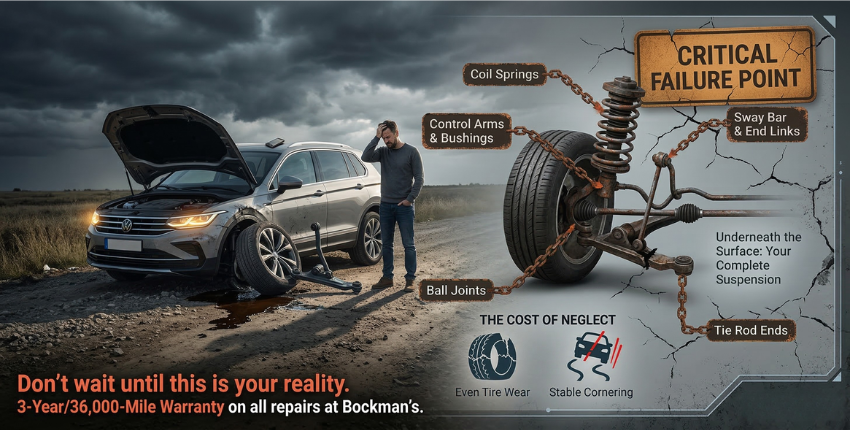
Think of your hip joint. Now put that at the corner of your car where the wheel connects to everything else. That’s essentially a ball joint. It lets your wheel move up and down over bumps while also turning left and right. Every pothole, every hard stop, every sharp corner puts force through those joints. When they wear out, you’ll hear a clunking or popping sound from the front end. When they fail completely, the wheel can collapse outward. That’s about as bad as it sounds.
Control Arms and Bushings
Control arms are what connect your wheels to the frame of the vehicle. They’re tough, but at each end there’s a rubber bushing that absorbs vibration and cushions the movement. Rubber doesn’t last forever. It dries out, cracks, and eventually gives up. When the bushings go, you feel every imperfection in the road like there’s nothing there to soften it. Because there isn’t.
Sway Bar and End Links
The sway bar runs across the vehicle and fights body roll when you’re taking a corner. It keeps the car from leaning like it’s trying to dump you out the window. The end links and bushings that connect it to the suspension are small parts that wear out regularly. When they go, you get a rattling or clunking sound over bumps, especially at low speed. It sounds alarming. It’s usually not expensive. But it’s worth fixing before it causes problems elsewhere.
Springs
Coil springs hold the actual weight of the car. When a spring sags or breaks, one corner of the car sits lower than the others. You can sometimes see this just by standing back and looking at your car. A broken spring also forces your shocks and struts to work a lot harder than they were designed to, which speeds up wear on those parts too. One problem feeding another.
And Then There’s the Steering Side
The suspension and steering systems are closely connected, and when one has problems it almost always affects the other. One steering component worth knowing about is the tie rod end.
Tie Rod Ends
Tie rod ends connect the steering rack to your wheels. When you turn the steering wheel, tie rod ends are what actually translate that movement into your wheels turning. When they wear out, the steering gets vague and loose. The car might drift. The steering wheel might vibrate. Your tires might start wearing unevenly. Tie rod ends are sneaky because they tend to wear slowly and quietly, then announce themselves all at once.
How to Know Something’s Off
You don’t need to know anything about cars to notice these. You just need to pay attention.
The ride feels rougher than it used to. Not “I hit a big pothole” rough. More like the whole road just feels more aggressive than it used to.
The car pulls to one side. On a flat, straight road, your car should track without you fighting the wheel. If it consistently drifts left or right, suspension or steering wear is often involved.
You hear clunking, knocking, or creaking. Especially over bumps or when turning. Different sounds point to different parts, which is why “it makes a noise” is the beginning of the diagnosis, not the end.
Uneven tire wear. This one is easy to miss because you don’t stare at your tires that often. But if one edge is wearing faster than the other, or you see a cupped, scalloped pattern, that’s your car trying to tell you something.
The steering feels mushy or loose. More play in the wheel than there used to be. Less crisp response. That “connected” feeling has faded.
The car nose-dives hard when you brake. This one matters more than people realize. When your suspension is worn, the weight transfer during braking becomes sloppy. Your stopping distance actually gets longer. It’s not just a comfort thing. It’s a safety thing. Worn suspension means it takes more road to stop your car than it should.
A Real-World Example
We see this one all the time. A vehicle comes in for uneven tire wear. The tires look like the problem. After inspection, the real issue turns out to be worn suspension bushings or ball joints. Once those parts wear out, the alignment angles change and the tires start wearing unevenly.
Replacing the tires without fixing the underlying suspension problem just means the next set wears out early too. It’s an expensive lesson, and one that’s completely avoidable.
It’s All Connected (And Not in a Good Way)
Here’s the thing about suspension and steering problems. They don’t stay in their lane. A worn bushing changes the geometry of the whole front end, which throws off your alignment, which starts eating your tires, which changes how the car handles. What starts as one small worn part can work its way through control arms, tires, and steering components if it’s ignored long enough.
This is why we use Digital Vehicle Inspection technology at Bockman’s. We show you photos of what we’re actually seeing under your car, explain what it means, and let you decide. No pressure, no mystery. Just here’s what we found, here’s why it matters, here’s what it costs.
And everything we do is backed by our 3-year/36,000-mile warranty. That’s been the deal for over 60 years, since my dad Chuck opened the doors in 1964. It’s not changing.
So When Should You Have It Looked At?
If you’re over 60,000 miles and haven’t had a suspension check, it’s worth adding to the list. Most of these parts wear gradually, and by the time they’re making noise, they’ve usually been a problem for a while.
If you’re already noticing any of the symptoms above, don’t wait on it. Suspension and steering wear gets more expensive the longer it goes, and it affects your ability to actually control the vehicle. That’s not something to mess around with.
Common Questions
How long do suspension parts last?
Many suspension components begin showing wear between 60,000 and 100,000 miles, depending on road conditions and driving habits. Around here, with DeKalb County winters and the roads that come with them, the lower end of that range is pretty common.
Can worn suspension damage my tires?
Yes, and this is one of the sneakier ways suspension problems cost you money. When worn parts change your alignment angles, your tires start wearing unevenly. You end up replacing tires way earlier than you should have to.
Is it safe to drive with worn suspension?
Sometimes you can, for a while. But worn suspension affects steering control, braking performance, and overall stability. It’s not the kind of thing that gets better on its own. If something feels off, get it looked at.
Come see us at either of our DeKalb County locations. We’ll take an honest look, tell you what we find, and you can go from there. No pressure. We’re neighbors.
Don’t wait until a small suspension problem turns into a big bill — keep your car running right and your wallet happy.
Book online → Schedule your service online
Or give us a call:
DeKalb: 112 Industrial Dr. | 815-754-4200
Sycamore: 2158 Oakland Dr. | 815-756-7413
About the Author
Jon Bockman has owned and operated Bockman’s Auto, Truck & Tire since 1999, carrying on a family business his father Chuck founded in DeKalb County in 1964. Under Jon’s ownership, Bockman’s was named NAPA Shop of the Year — chosen from more than 18,000 NAPA Auto Care Centers nationwide — and has been voted Best Auto Repair Shop in the Daily Chronicle Readers’ Choice Awards 15 times. He oversees two locations in Sycamore and DeKalb and a team of 20 people who share one goal: treating every customer like a neighbor.