You know that friend who only goes to the doctor when something is already seriously wrong? Their arm is turning purple, they’re coughing up something green, and there’s a weird noise coming from somewhere that definitely shouldn’t be making noise.
A lot of people treat their tires the same way.
They ignore them until something is obviously, dramatically wrong. And by then, they’re looking at a repair bill that hurts a lot more than it needed to.
Here’s the thing, though. Tire rotations and alignments are not glamorous. Nobody brags about them at a backyard cookout. But they are genuinely one of the smartest, cheapest ways to protect one of the most expensive things you own. Let me explain what they actually do, why they matter, and what happens when you skip them.
What Is a Tire Rotation, and Why Do Your Tires Even Need It?
Your car does not treat all four tires equally. Front tires are doing the steering AND helping with braking. If you have a front-wheel-drive vehicle, they’re also doing the actual work of moving the car forward. That is a lot of work for two tires.
Back tires? They’re mostly just along for the ride.
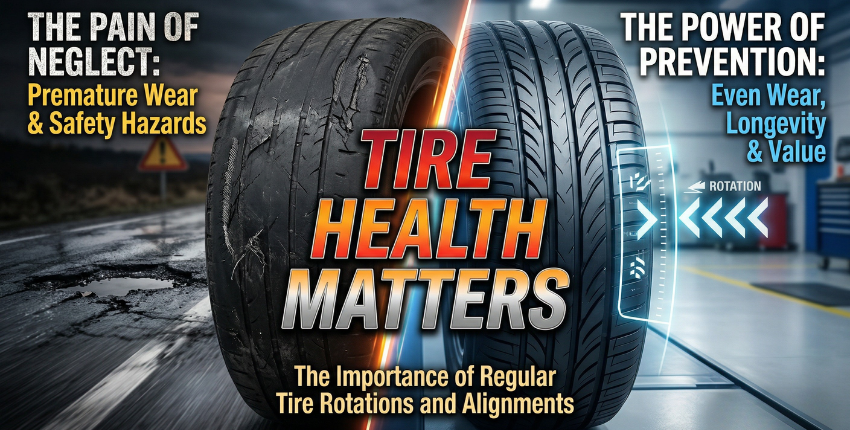
Because of this, your front tires wear down significantly faster than your rear tires. If you never rotate them, your front tires are going to look like your grandfather’s favorite chair cushion while your back tires still look practically new. That is uneven wear, and uneven wear is expensive.
A rotation is just moving the tires around so no single tire is always stuck doing the hardest job. Front goes to back, back comes to front, sides switch depending on your car and tire type. It balances out the wear so all four tires last as long as they possibly can.
Think of it like rotating your mattress. Same idea. Wear it the same way long enough and you’ll end up sleeping in a hole.
Okay But What Happens If I Just Skip It?
Great question, and I appreciate the honesty of asking it out loud.
Here’s what happens. Your front tires wear down much faster than they should. You end up replacing them way before the tires’ actual useful life is up. You spend money you didn’t need to spend. If the wear gets bad enough, you also start to notice things like vibration, pulling to one side, or tires that just plain feel weird at highway speeds.
Worse, worn front tires in wet or snowy conditions don’t grip the way they should. And DeKalb County winters will absolutely test that.
The rotation itself? Pretty inexpensive. A new set of tires because you skipped rotations for two years? That conversation is harder.
We recommend rotating your tires every 5,000 to 7,500 miles. A lot of our customers tie it to every oil change because it’s easy to remember and the timing lines up pretty well.
Now Let’s Talk Alignment
Alignment is a little different. Where a rotation is about managing wear, an alignment is about making sure your car is actually pointed and pulling the right direction.
Here’s the simple version. Your wheels have angles, set very precisely by your car’s manufacturer, that determine how they sit against the road. When those angles are right, your car drives straight, handles well, and your tires wear evenly. When those angles are off, even just a little bit, the tires start dragging slightly sideways instead of rolling cleanly forward. That side drag chews through tires fast. It also makes your car pull to one side, which is tiring on a long drive. And it can mess with your steering and suspension over time.
How Does Alignment Get Out of Whack?
Easier than you’d think.
Hitting a pothole at the wrong speed. Clipping a curb when you’re parking. A bigger bump or minor fender bender. Roads in Illinois in March. Honestly, sometimes just normal driving wear over time is enough.
You don’t have to do anything dramatic. Your alignment can drift gradually, and a lot of drivers don’t notice until a shop puts it on a machine and shows them the numbers.
Some signs it might be time for an alignment check:
- Your car pulls to the left or right when you let go of the wheel on a flat, straight road
- Your steering wheel is off-center even when driving straight
- Your tires are wearing unevenly, especially if one edge is wearing down faster than the rest
- Your car just feels a little squirrely or less confident than it used to
Rotations and Alignments Together Are a Powerful Combination
If you’re going to invest in one, invest in both. They work together. An alignment without a rotation still leaves uneven wear in place. A rotation without an alignment means you’re spreading that wear more evenly across all four tires, but the underlying reason for the wear is still there.
Together, they are the single best routine maintenance habit for keeping your tires lasting as long as they were built to last. Most quality tires are rated for 50,000 to 70,000 miles or more. How you maintain them is the difference between actually getting that mileage or getting half of it.
A Word About Getting the Work Done Right
This is not a task where “good enough” is good enough. A proper alignment requires a machine calibration and a trained technician reading the results. A rotation needs to be done correctly with the right torque on the lug nuts, which matters more than most people realize.
At Bockman’s, every vehicle that comes through gets a Digital Vehicle Inspection, which means we’re actually looking at your tires and your suspension components while we have your car up in the air, not just doing the job you asked for and calling it done. If something looks off, we’ll show you what we’re seeing and explain it in plain language so you can make a good decision.
We also have the Bockman Bucks loyalty rewards program, so regular maintenance visits like rotations actually add up to real savings on future services. Customers who keep up on the small stuff and earn rewards along the way are the ones who are always surprised by how reasonable their bigger services end up being.
If you need a ride while your car is in, we have a shuttle and loaner cars available. No reason to rearrange your whole day over a tire rotation.
The Bottom Line
Tires are not cheap. A good set for most vehicles runs anywhere from $600 to $1,000 or more installed. Taking care of them with regular rotations and occasional alignment checks is the simplest math in car ownership.
Spend a little now, regularly, on maintenance. Or spend a lot more later, all at once, on replacement.
We have been taking care of DeKalb County drivers since 1964. Sixty years of people trusting us with the thing that gets them to work, picks up their kids, and makes it through the winter. That is not something we take lightly.
Don’t wait until a small tire problem turns into a big bill — keep your car running right and your wallet happy.
Book online → Schedule your service online
Or give us a call:
DeKalb: 112 Industrial Dr. | 815-754-4200
Sycamore: 2158 Oakland Dr. | 815-756-7413
About the Author
Jon Bockman has owned and operated Bockman’s Auto, Truck & Tire since 1999, carrying on a family business his father Chuck founded in DeKalb County in 1964. Under Jon’s ownership, Bockman’s was named NAPA Shop of the Year — chosen from more than 18,000 NAPA Auto Care Centers nationwide — and has been voted Best Auto Repair Shop in the Daily Chronicle Readers’ Choice Awards 15 times. He oversees two locations in Sycamore and DeKalb and a team of 20 people who share one goal: treating every customer like a neighbor.